

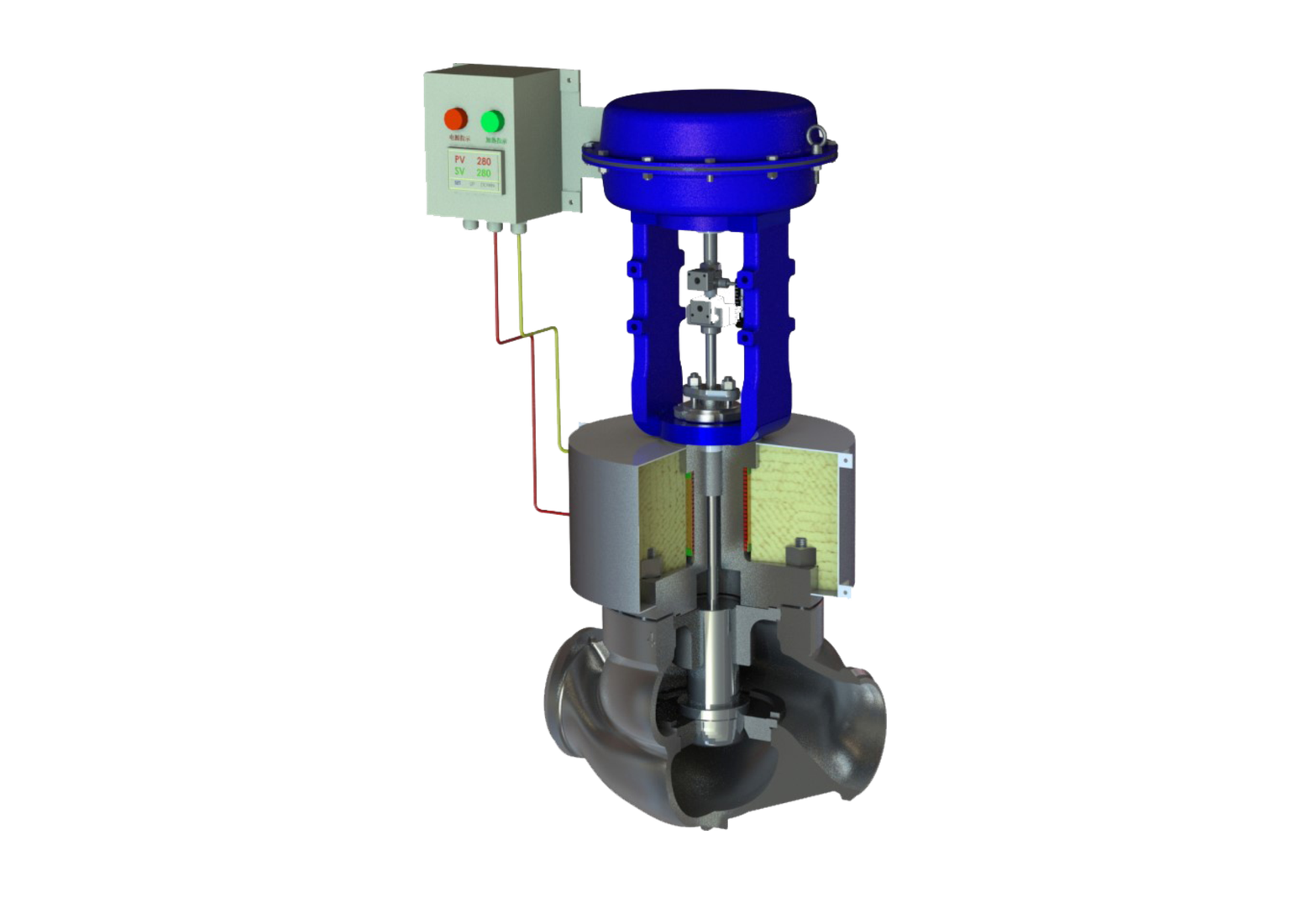
H200 Molten Salt Regulating Valve
It is a single-seat type with a plunger-type valve core. It has a simple structure, avoiding excessive molten salt accumulation blind spots in the flow channel due to overly complex design, and also reducing the phenomenon of parts jamming due to high-temperature expansion and deformation. By using special packing components, the molten salt valve allows medium temperatures to reach 600°C.
Technical data
| Nominal Pressure | Class150~Class2,500; PN16~PN420 | Nominal Diameter | DN32~DN250; 1-1/4”~10” |
| Operating Temperature | -45℃~+600℃ | End Connection | Flange , Welding |
| Leakage Rating | Class IV, Class V |
Features & Benefits
The flow channel has no blind spots.
There are no dead corners in the flow channel, and molten salt does not remain or accumulate liquid, fundamentally avoiding crystallization blockage caused by local low temperature.
Full-process heat tracking design
The valve body is either jacketed (steam/heat transfer oil) or electrically heated, and the matching valve stem and valve cover are both heated to ensure that the temperature at any point inside the valve is higher than the solidification point of molten salt. Some designs also feature insulated shells to reduce heat loss.
Extended valve cover (radiator neck)
The valve cover has an extended structure to keep the packing sealing area away from the high-temperature valve body, so that the packing works within the tolerable temperature range.
Special materials and surface hardening treatment
Valve body/internal components: high-temperature resistant alloys such as 316H, 347H, Hastelloy, and Inconel; Sealing surface: Stellite alloy overlay welding, wear-resistant and erosion-resistant;
Valve body/internal components: high-temperature resistant alloys such as 316H, 347H, Hastelloy, and Inconel; Sealing surface: Stellite alloy overlay welding, wear-resistant and erosion-resistant;
The clearance between the guide surface and the sealing surface of the valve core is calculated and simulated to ensure sealing while allowing for thermal expansion, thus avoiding high-temperature expansion that could cause the valve stem to clog.