


Data Center Industry (Liquid Cooling System) Solutions
Application Overview
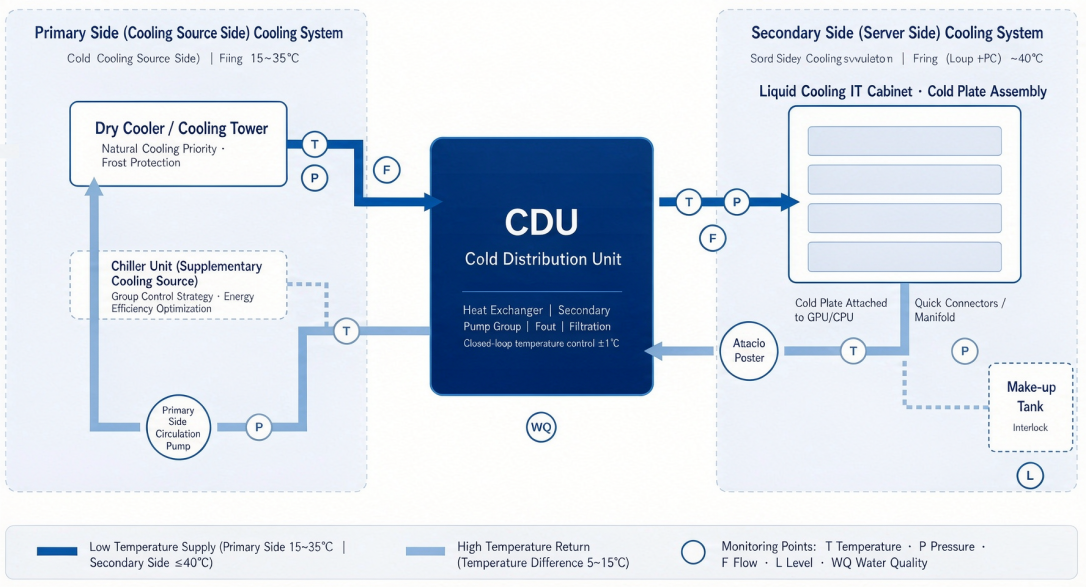
AI and high-performance computing continue to raise rack power density, and single-rack heat loads now exceed the practical limit of air cooling. Liquid cooling has become a key technology for large AI and HPC data centers, where the cooling loop directly determines whether compute performance can be sustained. These systems run 24/7 and require precise measurement and control of temperature, pressure, flow and coolant quality across the loop to handle load swings and risks such as leakage or coolant degradation.
Through full-loop data acquisition, closed-loop control and early risk warning, we provide the measurement and control foundation for stable operation and energy-efficiency optimization of the cooling system.
Industry Challenges
1.Highly volatile loads
AI workloads fluctuate in tidal patterns, causing transient heat-load swings in the cooling loop and demanding fast, wide-range measurement and control response.
2.Continuous operation
Uninterrupted year-round duty requires long-term stability of every instrument and valve.
3.Multi-branch balancing
CDU supplies multiple branches; uneven flow distribution calls for high measurement consistency and precise balancing control.
4.Demanding media
Deionized water, glycol and dielectric coolants are prone to degradation, ion release and leakage, requiring online monitoring of medium condition.
5.Energy-efficiency compliance
System performance is tied directly to PUE, and measurement accuracy influences cooling energy consumption.
Solution Overview
1.Control System Solution
(1)PAS300 DCS
PAS300 DCS provides integrated control from the heat-rejection source and CDU to the distribution network and rack terminals. High-speed PID computation enables free-cooling-priority coordination, a fully redundant architecture ensures uninterrupted control on the source side, multi-protocol support connects outdoor weather data, and interlocks cover source-side control valves, isolation butterfly valves and pump sets.
(2)Customer Value
Built on PAS300 DCS, the heat-rejection source, CDU heat-exchange units, room distribution network and rack terminals are managed as one coordinated system, providing the control foundation for stable liquid-cooling operation.
Full-loop measurement and control deliver the data basis for PUE optimization and support phased, smooth capacity expansion, helping shorten on-site commissioning and reduce commissioning and life-cycle maintenance effort.
2. Instrumentation
(1)Primary Loop Heat Rejection (Cooling Tower / Dry Cooler, Primary Pump, Primary Control Valve)
1)Supply temperature / fan speed closed loop: Supply temperature is fed back in real time and cooling tower or dry cooler fan speed is modulated to the target approach temperature.
2)Flow measurement, 0.2 % accuracy: MF electromagnetic flow-meters provide accurate primary-loop circulation and makeup-water measurement.
3)Overshoot-free actuation: M8000 variable-speed positioning with soft start/stop mitigates water hammer and extends valve service life.
4)Outdoor-rated: IP67 (optional IP68) protection and wide temperature range suit year-round rooftop heat-rejection service.
(2)Plate Heat Exchanger / Heat-Exchange Station (Primary-to-Secondary Interface)
1)High-accuracy differential pressure: PDS843 captures subtle changes in exchanger flow resistance for early detection of fouling and scaling.
2)Long-term stability: PDS smart pressure transmitters use a monocrystalline-silicon composite sensor and compensation algorithm for ±0.1 % / 10-year stability.
3)Synchronized temperature measurement: Four-point supply and return temperature monitoring on both sides delivers real-time heat-exchange efficiency.
(3)Secondary Loop CDU / Cooling System (Secondary Pump, Supply / Return Manifold, Server Cold Plate)
1)Supply temperature closed loop: Temperature transmitters achieve ±0.1 % FS over the full range and ≤0.1 % FS / year stability, paired with Class A Pt100 RTDs.
2)Branch flow balancing: Smart control valves on manifold branches correct uneven flow distribution across racks and cold plates.
Related Products
1. PAS300 DCS
PAS300 distributed control system: thermal parameter acquisition, PID closed-loop control of pumps and control valves, equipment interlock protection, alarm and historical data management, with centralized monitoring of the primary and secondary liquid-cooling loops.
2. Flow Instruments
MF electromagnetic flow-meter: primary-loop circulation and makeup-water measurement, CDU primary and secondary circulating-water measurement.
VF vortex flow-meter: cooling-water and makeup-water branch flow, room distribution manifold branch measurement.
3. Temperature Instruments
SBWZ integrated temperature transmitter: supply-temperature closed-loop control, four-point medium temperature measurement, heat-exchange efficiency calculation.
4. Pressure Instruments
PDS smart pressure transmitter (PDS803 high-accuracy pressure / PDS843 high-accuracy differential pressure): pipeline pressure monitoring and micro-differential-pressure monitoring of CDU heat-exchange units and plate heat ex-changers.
5. Analytical Instruments
LEX2000 water-quality analyzer: coolant condition and ion-release trend monitoring, makeup-water quality monitoring.
6. Level Instruments
MPS7000 / MPS5000 radar level transmitters: CDU and small makeup-tank level monitoring.
MBK magnetic float level switch: interlock protection for makeup or circulation pumps.
7. Control Valves
ZJHR-1 soft-seated on/off ball valve: small and medium bore liquid-cooling loops requiring online maintenance and tight shutoff.
VBM rubber-lined butterfly valve: large-bore water-system mains where flow control is required.