Wastewater Treatment Industry Solution
Application Overview
Growing water scarcity and tightening regulations on wastewater treatment, water reuse, and discharge are raising the bar for municipal and industrial projects. Plants must cope with fluctuating influent quality, harsh site conditions, and rising energy and labor costs, while measurement and control must remain reliable and stable.
Wastewater plants face a dual challenge: high energy consumption and strict regulation. Aeration and lift pumps account for most of a plant’s power demand, yet effluent parameters must remain in compliance at all times. Measurement must therefore do more than provide accurate readings; it must support energy-saving control and provide evidence of compliance. We offer an integrated portfolio from field instruments to plant-wide control for municipal wastewater, industrial effluent, and water reuse projects worldwide.
Industry Challenges
1. Legacy plants with limited automation and persistently high energy consumption
2. Wide influent-quality swings and complex biological reaction processes.
3. Rising energy and chemical costs
4. Increasingly stringent environmental codes and local regulations
5. Harsh process media and site conditions
Solution Overview
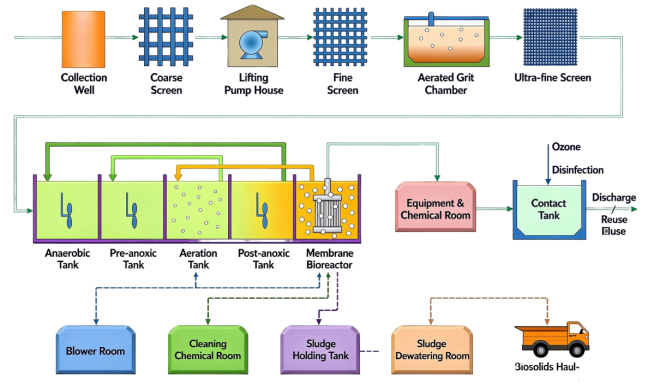
1. Wastewater Treatment Process Loop (Example)
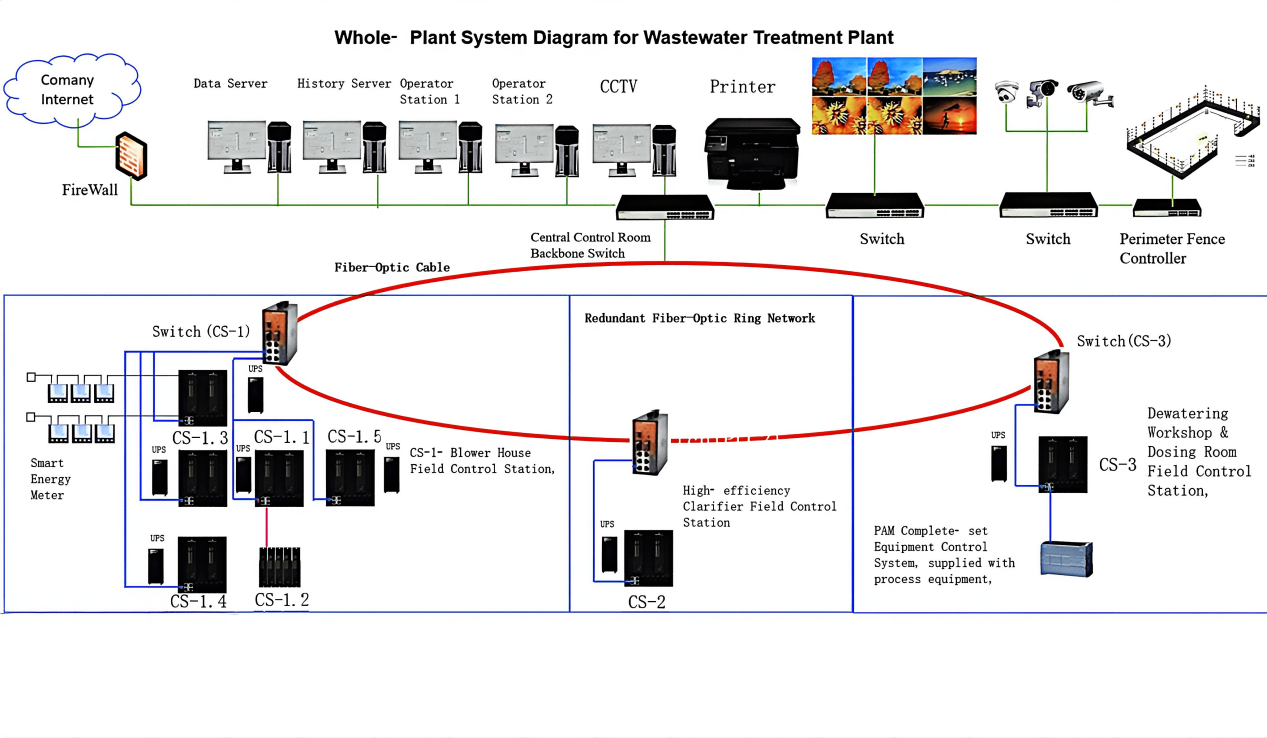
2. Control System Solution
(1)PAS300 Control System
PAS300 delivers plant-wide automation for the entire treatment process. Based on multi-parameter field measurements, it performs coupled closed-loop control of DO, MLSS, ammonia nitrogen, and other biological process parameters, while coordinating the scheduling of aeration blowers, lift pumps, and return-sludge pumps.
Comprehensive process safety interlocks cover pumps and valves, sludge and biogas units, and include fault protection and overflow prevention. A redundant fiber-optic ring architecture enables distributed coordination among plant sections and remote satellite pumping stations.
3. Instrumentation
Instruments are selected according to the medium and cover all measurement points from influent to effluent.
(1) Influent, effluent and reuse-water lines
MF series standard electromagnetic flowmeter. The full-bore, obstruction-free design ensures measurement is unaffected by changes in viscosity or density. Available in sizes from DN2.5 to DN2400, with selectable liners and electrodes for media containing solids.
(2)Return-sludge and waste-sludge lines
MFD slurry-type electromagnetic flowmeter. Multi-frequency excitation stabilizes the zero point, conical electrodes resist scaling, and intelligent signal analysis suppresses sludge noise and drift, ensuring reliable measurement of sludge return ratio and waste sludge flow.
(3)Aeration basin and MBR tank level
MTP submersible level transmitter. It minimizes foam interference and replaces conventional float or radar devices that become inaccurate under foaming conditions.
(4)Clear-water tank and chemical storage tank level
Ultrasonic level meter. Non-contact measurement with no moving parts ensures simple installation and maintenance.
(5)Aeration air flow (blower mains and basin branch lines):
MFR-C insertion-type thermal mass gas flowmeter. It directly measures gas mass flow without temperature or pressure compensation and links to the DCS for coordinated control of air flow, dissolved oxygen, and energy.
(6)MBR transmembrane pressure
PDS843 high-accuracy differential pressure transmitter. Continuous transmembrane-pressure monitoring warns of membrane fouling; as membrane replacement is one of the largest single costs in a wastewater plant, early warning helps extend membrane life.
(7)Effluent quality (COD, ammonia nitrogen, total phosphorus, total nitrogen)
WS2000 integrated water-quality monitoring system. Multi-parameter measurement with standard-protocol output helps ensure effluent complies with local discharge limits.
(8)Sludge drying and incineration flue gas
PS8400-FT FTIR analyzer (SO2, NOx, HCl, HF, CO2, CO, CH4 and more) with DT600 laser dust monitor for particulate matter, enabling continuous emission concentration monitoring.
Customer Value
PAS300 helps customers keep the process stable and controllable, withstand influent load swings more effectively, and maintain consistent compliance with effluent standards. Energy-saving control and precise chemical dosing help reduce plant power and chemical consumption, and simplify compliance reporting required by local environmental regulations.
Field-proven, reliable instruments combined with predictive diagnostics help reduce unplanned downtime and on-site maintenance workload, supporting stable biological-process operation and optimized aeration energy use.
Related Products
1. PAS300 Control System
Plant-wide automation, process safety interlocks and distributed coordination, with centralized monitoring, tiered alarms, event traceability and compliance report output.
2. Flow Instruments
MF series electromagnetic flowmeter: influent / effluent / reuse-water measurement, return-sludge and waste-sludge measurement, chemical dosing.
RFC series metal-tube rotameter: low-flow dosing of flocculants, disinfectants and other chemicals.
VF series vortex flowmeter: steam measurement for sludge drying and incineration, plant utility gases.
3.Pressure Instruments
PDS smart pressure transmitter (PDS803 high-accuracy pressure / PDS843 high-accuracy differential pressure): MBR transmembrane pressure, plate heat-exchanger and pipeline micro-differential pressure.
4. Analytical Instruments
WS2000 integrated water-quality monitoring system: COD, ammonia nitrogen, total phosphorus and total nitrogen measurement with standard-protocol output and full data traceability.
PS8400-FT continuous emission monitoring system and DT600 laser dust monitor: emission monitoring for sludge drying and incineration facilities.
5. Level Instruments
HS-AW ultrasonic level meter and MPS radar level transmitter: clear-water tank and chemical storage tank level.